
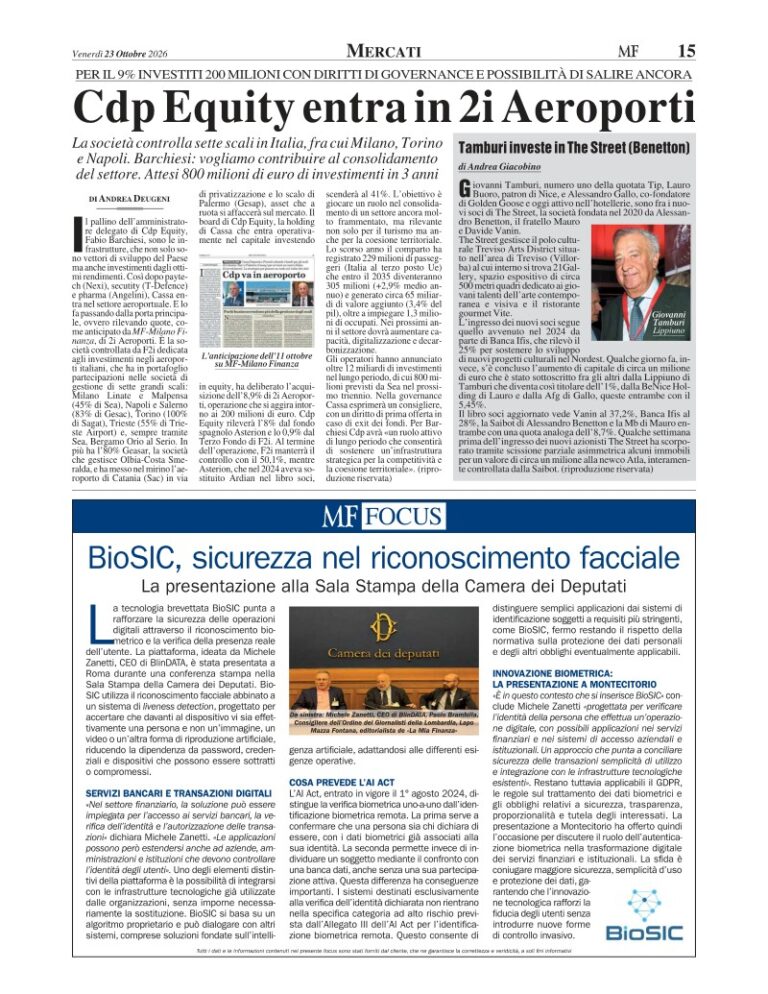
BIOSIC PER LA SICUREZZA NEL RICONOSCIMENTO FACCIALE.
LA PRESENTAZIONE ALLA SALA STAMPA DELLA CAMERA DEI DEPUTATI
La tecnologia brevettata BioSIC punta a rafforzare la sicurezza delle operazioni digitali attraverso il riconoscimento biometrico e la verifica della presenza reale dell’utente. La piattaforma, ideata da Michele Zanetti, CEO di BinDATA, è stata presentata a Roma durante una conferenza stampa nella Sala Stampa della Camera dei Deputati. BioSIC utilizza il riconoscimento facciale abbinato a un sistema di liveness detection, progettato per accertare che davanti al dispositivo vi sia effettivamente una persona e non un’immagine, un video o un’altra forma di riproduzione artificiale, riducendo la dipendenza da password, credenziali e dispositivi che possono essere sottratti o compromessi.
SERVIZI BANCARI E TRANSAZIONI DIGITALI
«Nel settore finanziario, la soluzione può essere impiegata per l’accesso ai servizi bancari, la verifica dell’identità e l’autorizzazione delle transazioni» dichiara Michele Zanetti. «Le applicazioni possono però estendersi anche ad aziende, amministrazioni e istituzioni che devono controllare l’identità degli utenti». Uno degli elementi distintivi della piattaforma è la possibilità di integrarsi con le infrastrutture tecnologiche già utilizzate dalle organizzazioni, senza imporne necessariamente la sostituzione. BioSIC si basa su un algoritmo proprietario e può dialogare con altri sistemi, comprese soluzioni fondate sull’intelligenza artificiale, adattandosi alle differenti esigenze operative.
COSA PREVEDE L’AI ACT
L’AI Act, entrato in vigore il 1° agosto 2024, distingue la verifica biometrica uno-a-uno dall’identificazione biometrica remota. La prima serve a confermare che una persona sia chi dichiara di essere, con i dati biometrici già associati alla sua identità. La seconda permette invece di individuare un soggetto mediante il confronto con una banca dati, anche senza una sua partecipazione attiva. Questa differenza ha conseguenze importanti. I sistemi destinati esclusivamente alla verifica dell’identità dichiarata non rientrano nella specifica categoria ad alto rischio prevista dall’AI Act per l’identificazione biometrica remota. Questo consente di distinguere semplici applicazioni dai sistemi di identificazione soggetti a requisiti più stringenti, come BioSIC, ferma restando il rispetto della normativa sulla protezione dei dati personali e degli altri obblighi eventualmente applicabili.
INNOVAZIONE BIOMETRICA: LA PRESENTAZIONE A MONTECITORIO
«È in questo contesto che si inserisce BioSIC» conclude Michele Zanetti «progettata per verificare l’identità della persona che effettua un’operazione digitale, con possibili applicazioni nei servizi finanziari e nei sistemi di accesso aziendali e istituzionali. Un approccio che punta a conciliare sicurezza delle transazioni e semplicità di utilizzo e integrazione con le infrastrutture tecnologiche esistenti». Restano tuttavia applicabili il GDPR, le regole sul trattamento dei dati biometrici e gli obblighi relativi a sicurezza, trasparenza, proporzionalità e tutela degli interessati. La presentazione a Montecitorio ha offerto quindi l’occasione per discutere il ruolo dell’autenticazione biometrica nella trasformazione digitale dei servizi finanziari e istituzionali. La sfida è coniugare maggiore sicurezza, semplicità d’uso e protezione dei dati, garantendo che l’innovazione tecnologica rafforzi la fiducia degli utenti senza introdurre nuove forme di controllo invasivo.
BIOSIC FÜR MEHR SICHERHEIT BEI DER GESICHTSERKENNUNG.
DIE PRÄSENTATION IM PRESSESAAL DER ABGEORDNETENKAMMER.
Die patentierte Technologie BioSIC zielt darauf ab, die Sicherheit digitaler Vorgänge durch biometrische Gesichtserkennung und die Überprüfung der tatsächlichen Anwesenheit des Nutzers zu erhöhen. Die von Michele Zanetti, CEO von BinDATA, entwickelte Plattform wurde in Rom im Rahmen einer Pressekonferenz im Presseraum der Abgeordnetenkammer vorgestellt. BioSIC kombiniert Gesichtserkennung mit einem Liveness-Detection-System, das sicherstellen soll, dass sich tatsächlich eine Person vor dem Gerät befindet und nicht lediglich ein Bild, ein Video oder eine andere Form künstlicher Wiedergabe. Dadurch soll die Abhängigkeit von Passwörtern, Zugangsdaten und Geräten, die gestohlen oder kompromittiert werden können, reduziert werden.
BANKDIENSTLEISTUNGEN UND DIGITALE TRANSAKTIONEN
„Im Finanzsektor kann die Lösung für den Zugang zu Bankdienstleistungen, die Identitätsprüfung und die Autorisierung von Transaktionen eingesetzt werden“, erklärt Michele Zanetti. „Die Anwendungsmöglichkeiten lassen sich jedoch auch auf Unternehmen, Verwaltungen und Institutionen ausweiten, die die Identität ihrer Nutzer überprüfen müssen.“
Eines der besonderen Merkmale der Plattform ist ihre Fähigkeit, sich in die bereits von Organisationen genutzten technologischen Infrastrukturen zu integrieren, ohne dass diese zwingend ersetzt werden müssen. BioSIC basiert auf einem proprietären Algorithmus und kann mit anderen Systemen interagieren, darunter auch mit Lösungen auf Basis künstlicher Intelligenz. Dadurch lässt sich die Technologie an unterschiedliche betriebliche Anforderungen anpassen.
WAS DER AI ACT VORSIEHT
Der am 1. August 2024 in Kraft getretene AI Act unterscheidet zwischen der biometrischen Verifizierung im Eins-zu-eins-Verfahren und der biometrischen Fernidentifizierung. Bei der Verifizierung im Eins-zu-eins-Verfahren wird bestätigt, dass eine Person tatsächlich diejenige ist, für die sie sich ausgibt. Dabei werden biometrische Daten verwendet, die bereits ihrer Identität zugeordnet sind. Die Fernidentifizierung hingegen dient dazu, eine Person durch den Abgleich mit einer Datenbank zu identifizieren, auch ohne ihre aktive Mitwirkung.
Dieser Unterschied hat wichtige Konsequenzen. Systeme, die ausschliesslich zur Überprüfung einer behaupteten Identität eingesetzt werden, fallen nicht unter die spezifische Hochrisikokategorie, die der AI Act für die biometrische Fernidentifizierung vorsieht. Dadurch lassen sich einfache Verifizierungsanwendungen von biometrischen Identifizierungssystemen unterscheiden, für die strengere Anforderungen gelten. Auch bei BioSIC müssen jedoch die Datenschutzvorschriften sowie alle weiteren gegebenenfalls anwendbaren rechtlichen Verpflichtungen eingehalten werden.
BIOMETRISCHE INNOVATION: DIE PRÄSENTATION IN MONTECITORIO
„In diesem Kontext ist BioSIC einzuordnen“, erklärt Michele Zanetti abschliessend. „Die Technologie wurde entwickelt, um die Identität der Person zu überprüfen, die einen digitalen Vorgang durchführt. Mögliche Anwendungsbereiche sind Finanzdienstleistungen sowie Zugangssysteme in Unternehmen und Institutionen. Der Ansatz zielt darauf ab, die Sicherheit von Transaktionen mit einer einfachen Nutzung und der Integration in bestehende technologische Infrastrukturen zu verbinden.“
Weiterhin gelten jedoch die Bestimmungen der Datenschutz-Grundverordnung (DSGVO), die Vorschriften zur Verarbeitung biometrischer Daten sowie die Anforderungen an Sicherheit, Transparenz, Verhältnismässigkeit und den Schutz der betroffenen Personen.
Die Präsentation in Montecitorio bot somit Gelegenheit, über die Rolle der biometrischen Authentifizierung bei der digitalen Transformation von Finanzdienstleistungen und institutionellen Angeboten zu diskutieren. Die Herausforderung besteht darin, mehr Sicherheit, Benutzerfreundlichkeit und Datenschutz miteinander zu verbinden und sicherzustellen, dass technologische Innovation das Vertrauen der Nutzer stärkt, ohne neue Formen invasiver Kontrolle einzuführen.
BioSIC for Enhanced Security in Facial Recognition. The Presentation at the Press Room of the Chamber of Deputies.
The patented BioSIC technology aims to strengthen the security of digital operations through biometric recognition and verification of the user’s actual presence. The platform, developed by Michele Zanetti, CEO of BinDATA, was presented in Rome during a press conference held in the Press Room of the Chamber of Deputies. BioSIC combines facial recognition with a liveness detection system designed to verify that an actual person is in front of the device, rather than an image, a video or another form of artificial reproduction. This reduces reliance on passwords, credentials and devices that can be stolen or compromised.
BANKING SERVICES AND DIGITAL TRANSACTIONS
“In the financial sector, the solution can be used to access banking services, verify identities and authorise transactions,” says Michele Zanetti. “However, its applications can also extend to companies, public administrations and institutions that need to verify the identities of their users.”
One of the platform’s distinguishing features is its ability to integrate with the technological infrastructures already used by organisations, without necessarily requiring them to be replaced. BioSIC is based on a proprietary algorithm and can interact with other systems, including solutions powered by artificial intelligence, adapting to different operational requirements.
WHAT THE AI ACT PROVIDES FOR
The AI Act, which entered into force on 1 August 2024, distinguishes between one-to-one biometric verification and remote biometric identification. The former is used to confirm that a person is who they claim to be, using biometric data already associated with their identity. The latter, by contrast, identifies an individual by comparing their biometric data against a database, even without their active participation.
This distinction has important implications. Systems intended exclusively to verify a claimed identity do not fall within the specific high-risk category established by the AI Act for remote biometric identification. This makes it possible to distinguish straightforward verification applications from biometric identification systems subject to stricter requirements. Nevertheless, BioSIC must still comply with personal data protection legislation and any other applicable legal obligations.
BIOMETRIC INNOVATION: THE PRESENTATION IN MONTECITORIO
“It is in this context that BioSIC comes into play,” concludes Michele Zanetti. “The technology was designed to verify the identity of the person carrying out a digital operation, with potential applications in financial services and access systems for businesses and institutions. This approach aims to combine transaction security with ease of use and integration into existing technological infrastructures.”
The GDPR, the rules governing the processing of biometric data, and the obligations relating to security, transparency, proportionality and the protection of data subjects nevertheless remain applicable.
The presentation in Montecitorio therefore provided an opportunity to discuss the role of biometric authentication in the digital transformation of financial services and institutional systems. The challenge is to combine greater security, ease of use and data protection, ensuring that technological innovation strengthens users’ trust without introducing new forms of intrusive control.